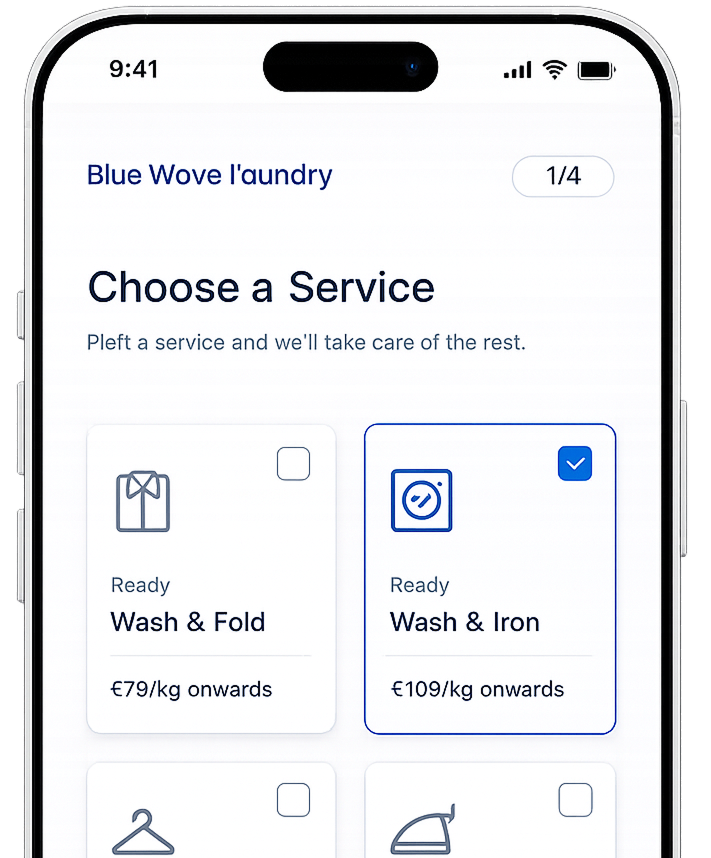
Lead Product & Service Design
Blue Wave Laundry.
Customers hand over their clothes before they know the final bill. The product was designed to make that moment predictable, transparent, and trustworthy.

02
The user problem
The real competitor wasn't another laundry. It was distrust.
Customers didn't leave over price. They left over unexpected bills, missed pickups, and never knowing where their clothes were.
The counter where every order starts and ends.
03
Role & constraints
Designing the product meant designing the service behind it.
Leading design end to end meant every interface decision carried an operational cost. Mapping the full order lifecycle kept the product honest, and it had to survive four hard constraints:
- 01No payment gateway — the fees never made sense at this scale.
- 02No real price until the clothes were weighed after pickup.
- 03Three connected apps to build: customer, staff, and owner.
- 04All of it manageable by one person.
04
Inside the service
The actual shop
05 — The insight
The hardest moment isn't washing the clothes. It's handing them over before knowing the price.
Get that one moment right, and everything after it becomes easy.
06
Decisions & trade-offs
Every decision demands a price.
{{ d.title }}
{{ d.problem }}
{{ d.options }}
{{ d.chose }}
Trade-off — {{ d.gaveUp }}
07
How the service works
One service, three connected experiences.
{{ g.tag }}
{{ g.name }}
{{ g.lead }}
{{ g.decision }}
{{ g.tag }}
{{ g.name }}
{{ g.lead }}
{{ g.decision }}
08
Outcomes
of customers came back for a second order — the outcome that mattered most.
A live service ecosystem with connected customer, staff, and owner apps — refined continuously against the real order lifecycle over eight months.
09 — Reflection
What looked like a laundry app was really the design of the ten seconds after a stranger takes your clothes and before you know what you owe.
This project shows how product design and service design work together to solve trust problems in an offline-first industry — starting from real constraints rather than ideal flows, because the solutions that survive are the ones that hold up in the real world, not just on the canvas.